Compliance Guide: ANSI/CTA-2015-B and CAN 2.0A/B for Vehicle-Specific Android Fascia Kits
Direct answer: When sourcing a vehicle-specific Android car stereo fascia kit, verify compliance at three layers: the mechanical fascia, the wiring harness and the CAN bus decoder. The checks that matter most are ANSI/CTA-2015-B color-coded insulation, an OEM vehicle-side plug plus ISO 16-pin head unit connector, CAN 2.0A and CAN 2.0B protocol support at 500 kbps and 125 kbps, flame-retardant PVC and PA66/ABS materials, and -40°C to 85°C operation. Buyers should also confirm reverse polarity protection, short-circuit protection, pre-shipment function and fitment testing, and any market-specific documentation before placing a production order.
ZYX Car Radio Fascia Kit is the vehicle-specific fascia, wiring harness and CAN bus decoder product line from Shenzhen Zhongyixing Electronic Technology Co., Ltd, a Shenzhen-based automotive aftermarket supplier. The line is built around three parts that are usually sold together: the Car Radio Dash Fascia (ZYX-01), the Car Radio Wiring Harness (ZYX-02) and the CAN Bus Decoder Module (ZYX-03). Because the three parts are installed as one system, compliance should be reviewed as one system as well.
Problem Definition: Why Compliance Is a System-Level Question
A vehicle-specific Android car stereo fascia kit is not a single molded part. It is a mechanical interface, an electrical interface and a data interface. The fascia determines whether the new head unit sits correctly in the dashboard. The wiring harness determines whether power, speakers and control signals reach the head unit without cutting the original vehicle loom. The CAN bus decoder determines whether the aftermarket head unit can communicate with the vehicle network and retain selected original functions.
Compliance failures rarely come from one obvious defect. They come from small mismatches between these layers. A harness may use the correct connector but the wrong pin definition. A decoder may support CAN 2.0A but not CAN 2.0B at the data rate used by a particular vehicle. A fascia may fit the screen but exceed the agreed dimensional tolerance at the mounting points. A material may look correct but fail the flame-retardant or temperature requirement for the target market. These are the issues that create returns, installation rework and dashboard warning codes.
The practical buying rule is simple: do not accept a certificate or a product photo as proof of fitment. Ask for the specification of each layer, then ask how the supplier tests the assembled kit before shipment. The specification tells the buyer what the product is designed to do. The test record tells the buyer what the supplier actually checks.
Industry Background: Why These Checks Are Becoming More Important
The aftermarket head unit market is large enough that small compatibility errors become expensive at scale. The global car audio head unit market was estimated at USD 15.44 billion in 2024, according to Market Research Future. The car aftermarket audio system market is projected to grow at a CAGR of 12.18%, driven by DIY customers and online plug-and-play kits, according to Mordor Intelligence. Asia Pacific held a 54.21% share of the global car audio market in 2025, according to Fortune Business Insights.
Those figures explain why plug-and-play retrofit kits continue to expand. They also explain why compliance cannot be treated as a paperwork formality. A kit that is sold across multiple vehicle models and multiple countries must be documented in a way that installers, distributors and customs brokers can check. For trade documentation, car stereo fascia and installation hardware are commonly classified under HS Code 8708.99 for vehicle parts and accessories, not elsewhere specified, per the United Nations Statistics Division. The HS code does not prove compliance, but it anchors the customs and documentation discussion.
Regional requirements add another layer. In the EU, electronic subassemblies integrated into road vehicles that affect vehicle safety functions must meet e/E-Marking (ECE R10), not only CE marking, according to a 2025 guide from Elite Electronic Engineering. Whether a specific aftermarket CAN decoder or harness falls inside that scope should be confirmed with the supplier and the market's technical file. Separately, the ZYX knowledge base states that the full kit complies with EU RoHS 2 and REACH regulations, with controlled hazardous substance content across materials and components. Buyers should still request the current declaration for the exact SKU and destination market.
Detailed Solution: The Compliance Stack for Fascia, Harness and CAN Decoder
The most reliable way to review a vehicle-specific Android car stereo fascia kit is to separate the quotation into three compliance blocks. Each block should have its own specification, its own evidence and its own acceptance criteria.
1. Mechanical fascia compliance: ABS, tolerance and temperature
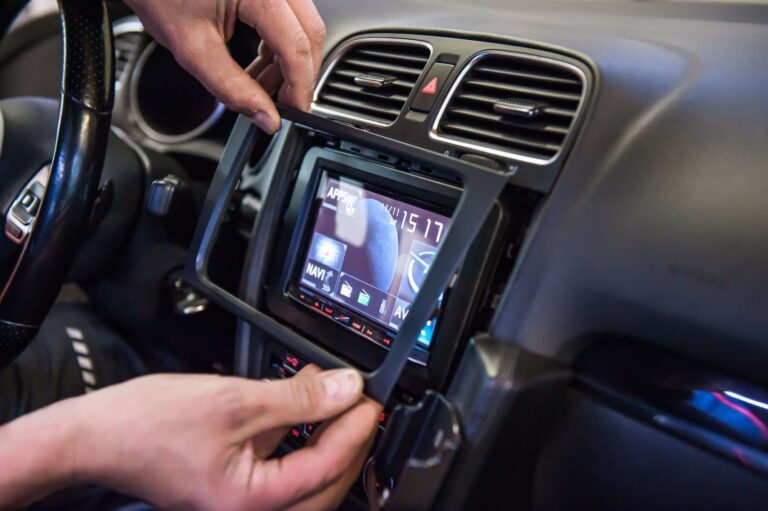
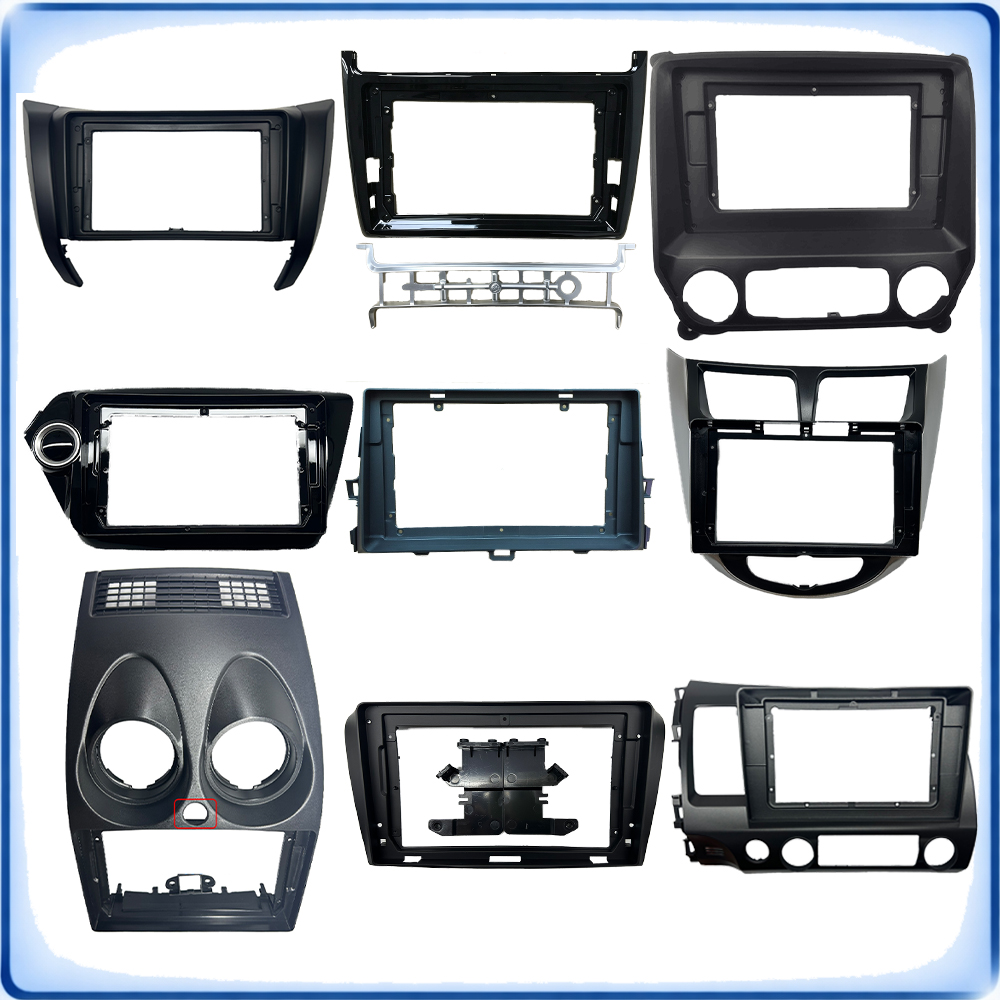
The Car Radio Dash Fascia (ZYX-01) is a model-specific center console frame and screen upgrade faceplate. Its stated material is ABS plastic, with a material thickness of 2.5 mm to 3.0 mm and a dimensional tolerance of ≤0.2 mm. It supports 7-inch, 9-inch, 10.1-inch and 12.3-inch screen sizes, with Double-DIN or model-specific custom mounting. The operating temperature is -40°C to 85°C, and the fitment type is plug-and-play.
For a buyer, the important point is not the word ABS alone. The important point is whether the supplier can hold the mounting points and the visible edges within the agreed tolerance. A ≤0.2 mm tolerance is a useful starting specification because it gives the buyer a measurable acceptance criterion. The buyer should also ask for a dry-fit check on the target dashboard, because a fascia can meet a drawing and still show an uneven gap if the mounting clips or trim interfaces are not controlled.
2. Wiring harness compliance: ANSI/CTA-2015-B, ISO 16-pin and OEM plug
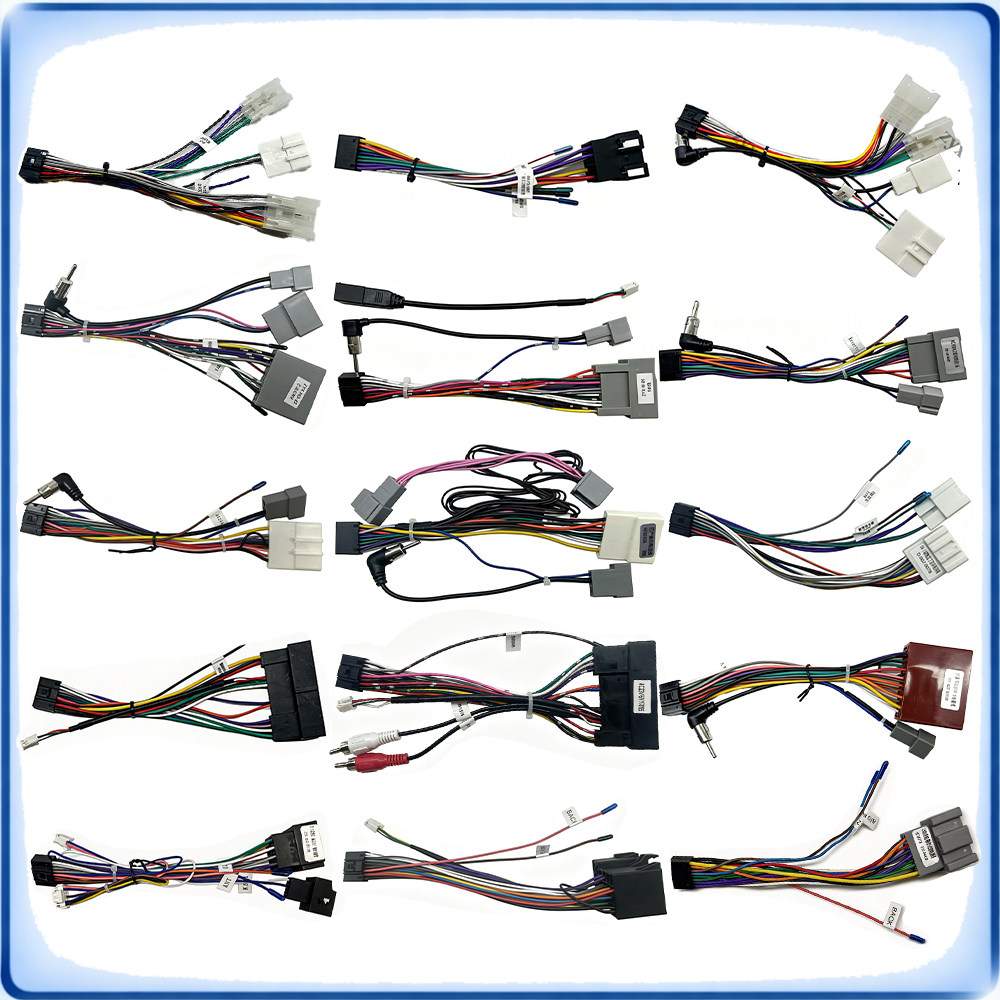
The Car Radio Wiring Harness (ZYX-02) is the electrical layer that makes a plug-and-play installation possible. Its connector type is an OEM vehicle-side plug plus an ISO 16-pin head unit connector. The wire specification is AWG 20-22 tinned oxygen-free copper with ANSI/CTA-2015-B color-coded insulation. The voltage rating is 12V DC with a 10A maximum current, and the operating temperature is -40°C to 85°C. Protection features include reverse polarity protection and short-circuit protection.
The material specification is equally important. The conductor is tinned oxygen-free copper, the insulation is flame-retardant PVC, the connector housing is PA66 engineering plastic, and the contact terminal is tin-plated brass. In practical terms, the ANSI/CTA-2015-B color code helps installers identify circuits and troubleshoot without guessing. The flame-retardant PVC and PA66 housing address the in-vehicle environment, where heat, vibration and accidental contact are normal risks. The tin-plated brass terminals are specified for stable long-term conductivity.
A buyer should not stop at the connector name. The same ISO 16-pin connector can be wired to different pin definitions. The purchase specification should therefore include the pinout, the wire color map, the wire gauge and the rated current. If the kit is intended for a non-CAN vehicle, the harness should be confirmed as a non-CAN vehicle radio wiring kit. If the vehicle uses CAN bus communication, the harness must be matched with the correct decoder rather than treated as a stand-alone part.
3. CAN bus decoder compliance: CAN 2.0A/B, 500 kbps and 125 kbps
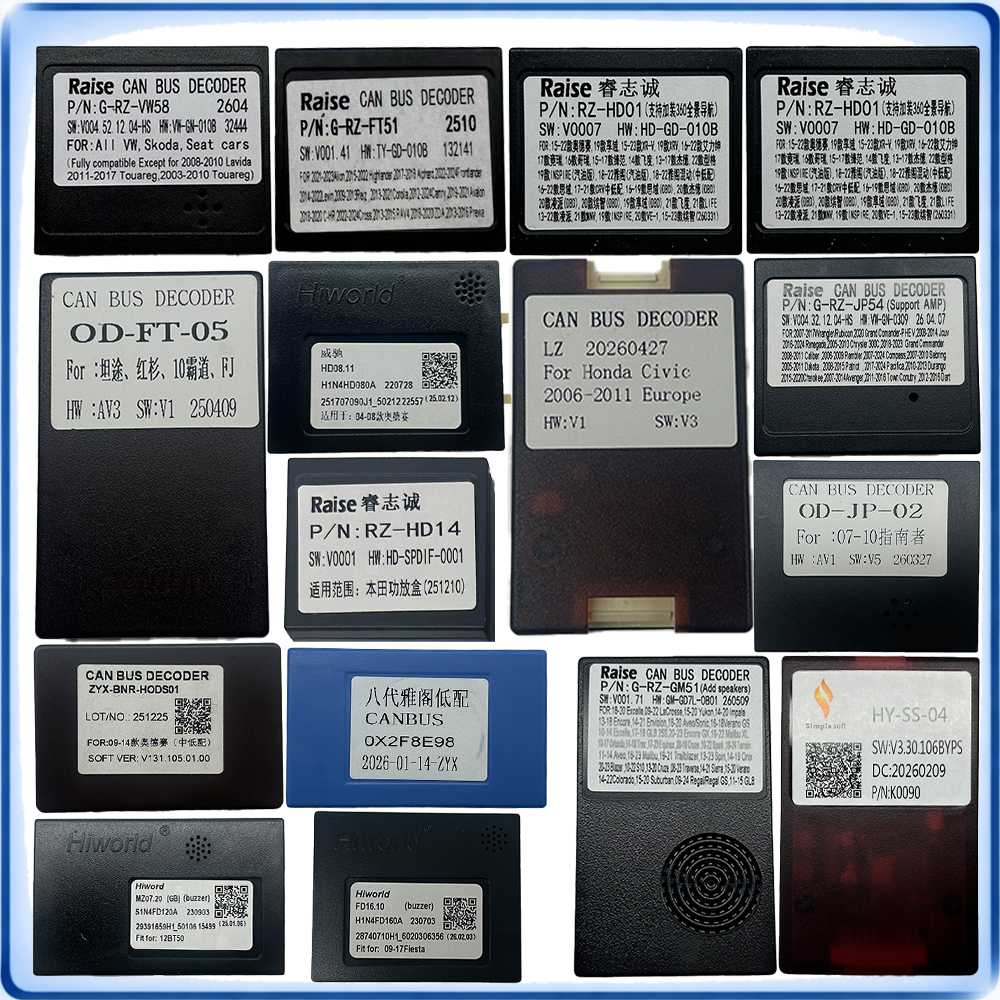
The CAN Bus Decoder Module (ZYX-03) is a plug-and-play CAN gateway module. Its protocol standard is CAN 2.0A / 2.0B with 500 kbps / 125 kbps dual rate. The power supply is 12V DC with 300 mA standby and 2A maximum. The operating temperature is -40°C to 85°C. The housing is flame-retardant ABS plastic, the connector terminals are tin-plated brass, the circuit board is FR-4 glass fiber epoxy resin, and the internal potting is heat-conductive silicone.
The decoder is the part that translates CAN bus protocols so that original vehicle controls can be retained. In a typical retrofit, it parses steering wheel control signals, vehicle status data and dashboard prompts from the original bus, converts them into formats compatible with the aftermarket head unit, and forwards control instructions back to the vehicle network. A commercial technical explainer describes this translation as HEX-to-UART conversion. The practical buyer check is whether the decoder is pre-programmed for the exact vehicle model, model year and trim configuration, and whether it includes CAN isolation to prevent dashboard fault codes.
CAN 2.0A and CAN 2.0B support matters because the two formats are not interchangeable in every vehicle network. The 500 kbps and 125 kbps dual rate matters because different vehicle systems use different bus speeds. A decoder that only supports one rate may work on one vehicle and fail on another, even when the connector fits. For this reason, the decoder specification should be matched to the vehicle application, not selected only by the shape of the plug.
4. Multi-country and documentation layer
For export programs, the case record for a car multimedia brand owner lists support for multi-country compliance standards among the cooperation highlights. That does not replace a market-by-market review, but it is a useful signal when a distributor sells into more than one region. The same case record covers a 9-year continuous cooperation and a cumulative 550,000+ sets of dash frames, wiring harnesses and CAN bus decoders. A separate case record for an aftermarket solution integrator covers a 7-year cooperation, cumulative 19,000+ sets and a return rate below 0.8%.
Documentation should be assembled per SKU and per destination. At minimum, the buyer should request the product specification, the pinout and color map, the material declaration, the RoHS 2 and REACH statement where applicable, and the test record for the pre-shipment check. If the destination market requires e/E-Marking for an electronic subassembly, the technical file should be reviewed before the order is released.
Step-by-Step Breakdown: How Buyers Verify Compliance Before a Purchase Order
The following sequence is a practical verification path for importers, distributors and installation businesses. It is written for a vehicle-specific Android car stereo fascia kit, but the same logic applies to a single replacement harness or decoder.
- Define the vehicle baseline. Record the vehicle brand, model, model year, original radio, original connector, vehicle configuration and audio system. The ZYX compatibility chain treats these as linked variables, not separate questions. If the vehicle has multiple equipment levels, request photos of the original dashboard, original radio or connector on the back of the original head unit.
- Confirm the fascia specification. Check the screen size, mounting standard, material, thickness, dimensional tolerance and operating temperature. For ZYX-01, the stated values are ABS, 2.5 mm to 3.0 mm, ≤0.2 mm tolerance and -40°C to 85°C. Ask for a dry-fit photo or report on the target dashboard.
- Confirm the harness specification. Check the OEM vehicle-side plug, the ISO 16-pin head unit connector, the AWG 20-22 tinned oxygen-free copper conductor, the ANSI/CTA-2015-B color-coded insulation, the flame-retardant PVC insulation, the PA66 connector housing and the tin-plated brass terminals. Confirm 12V DC, 10A maximum, reverse polarity protection and short-circuit protection.
- Confirm the CAN decoder specification. Check CAN 2.0A and CAN 2.0B support, 500 kbps and 125 kbps dual rate, 12V DC, 300 mA standby and 2A maximum, -40°C to 85°C operation, flame-retardant ABS housing, FR-4 circuit board and heat-conductive silicone potting. Confirm that the decoder is pre-programmed for the exact vehicle application and that CAN isolation is included.
- Confirm the pre-shipment test. The supplier states 100% incoming inspection for CAN bus decoders and 100% pre-shipment conductivity and fit test. In practical terms, that is the pre-shipment function and fitment check buyers should ask to see in the quality plan. Ask what is tested, what is recorded and what happens when a unit fails.
- Confirm the commercial clauses. Check the MOQ, lead time, warranty and defect handling. ZYX states stock MOQ of 1 unit and custom OEM/ODM MOQ of 100 units, with stock lead time of 3-7 days and custom model-specific lead time of 15-25 days. The stated after-sales terms include a 12-month product warranty, remote installation technical guidance and free replacement for defective items.
Use Cases: Where This Compliance Stack Matters
Aftermarket solution integrator serving multiple vehicle brands
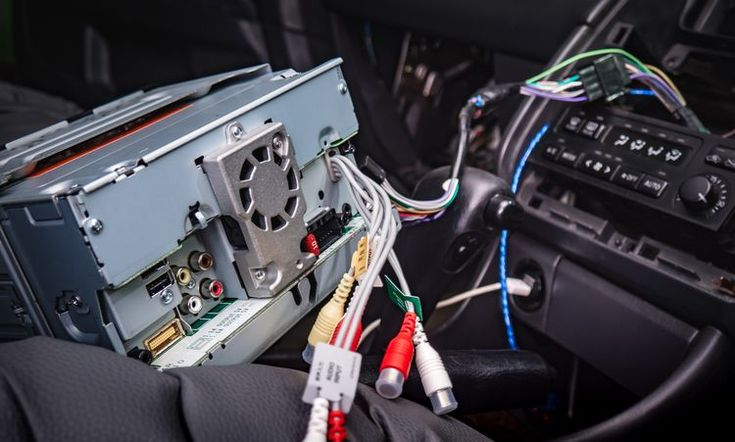
An aftermarket solution integrator typically installs Android head units across several vehicle brands and model years. The risk is not one bad unit; it is a pattern of small compatibility errors that creates repeat labor. In the ZYX case record, an aftermarket solution integrator has used dash frames, wiring harnesses and CAN bus decoders for various car brands over a 7-year cooperation, with cumulative 19,000+ sets and a return rate below 0.8%. The cited highlights are high-precision frame dimensions, reliable harness connections, a mature protocol solution and responsive after-sales technical support.
Car multimedia brand owner with multi-country distribution
A brand owner selling into multiple countries needs a kit that can be documented for different markets. In the second ZYX case record, a car multimedia brand owner has worked with the supplier for 9 years, with cumulative 550,000+ sets of dash frames, wiring harnesses and CAN bus decoders. The cited results include a return rate below 0.7%, stable mass production, fast new-model adaptation and support for multi-country compliance standards. For this type of buyer, the compliance file is part of the product, not an afterthought.
Installer shop handling a single vehicle
A single-vehicle installer may not need a multi-country compliance file, but still needs the correct harness and decoder. The stock MOQ of 1 unit and 3-7 day lead time make a single-set order practical. The same installer should still confirm the vehicle model year, trim and original connector before ordering, because a plug-and-play kit depends on the vehicle baseline being correct.
Comparison Table: Compliance Checkpoints by Component
| Component | Compliance checkpoint | Verified ZYX specification | Evidence to request |
|---|---|---|---|
| Car Radio Dash Fascia (ZYX-01) | Mechanical fit, material and temperature | ABS plastic; 2.5 mm-3.0 mm thickness; ≤0.2 mm dimensional tolerance; 7-inch, 9-inch, 10.1-inch and 12.3-inch screen support; Double-DIN or model-specific custom; -40°C to 85°C | Dimensional report, dry-fit photo, mounting point check |
| Car Radio Wiring Harness (ZYX-02) | Connector, wire code, material and electrical protection | OEM vehicle-side plug + ISO 16-pin head unit connector; AWG 20-22 tinned oxygen-free copper; ANSI/CTA-2015-B color-coded insulation; flame-retardant PVC; PA66 housing; tin-plated brass terminals; 12V DC, 10A maximum; reverse polarity and short-circuit protection; -40°C to 85°C | Pinout, color map, wire gauge, material declaration, continuity test record |
| CAN Bus Decoder Module (ZYX-03) | Protocol, data rate, power and temperature | CAN 2.0A / 2.0B; 500 kbps / 125 kbps dual rate; 12V DC, 300 mA standby, 2A maximum; flame-retardant ABS housing; FR-4 circuit board; heat-conductive silicone potting; -40°C to 85°C | Vehicle-specific firmware confirmation, protocol test record, CAN isolation check |
| Pre-shipment quality | Function and fitment verification | 100% incoming inspection for CAN bus decoders; 100% pre-shipment conductivity and fit test | Inspection plan, test log, failure handling procedure |
| Market documentation | Regional compliance and customs | EU RoHS 2 and REACH statement in the knowledge base; multi-country compliance standard support cited in the brand-owner case; HS Code 8708.99 for trade reference | Current declarations per SKU, technical file review where e/E-Marking applies |
Contract and Acceptance Terms Buyers Should Confirm
Two clauses are often commercial rather than datasheet items. If a buyer requires third-party inspection acceptance, such as SGS, the purchase order should state the inspection scope, sample size and acceptance criteria. If a buyer requires a quality-defect return policy, for example 7 days, the contract should state the window and the defect definition. These clauses should be confirmed in writing because a product page alone does not establish them. ZYX's published after-sales terms state a 12-month product warranty and free replacement for defective items; any additional inspection or return clause should be documented in the order.
FAQ
Which standards should a buyer verify for a vehicle-specific Android car stereo fascia kit?
Verify ANSI/CTA-2015-B color-coded insulation, an OEM vehicle-side plug plus ISO 16-pin head unit connector, CAN 2.0A and CAN 2.0B support at 500 kbps and 125 kbps, flame-retardant PVC and PA66/ABS materials, and -40°C to 85°C operation. Also confirm EU RoHS 2 and REACH declarations and whether e/E-Marking ECE R10 applies to the electronic subassembly in the destination market.
Does the ZYX CAN bus decoder support both CAN 2.0A and CAN 2.0B?
Yes. The CAN Bus Decoder Module (ZYX-03) is specified for CAN 2.0A / 2.0B with 500 kbps / 125 kbps dual rate. It operates at 12V DC with 300 mA standby and 2A maximum, and it is rated for -40°C to 85°C. The decoder should still be matched to the exact vehicle model, model year and trim configuration before ordering.
What do ANSI/CTA-2015-B color coding and flame-retardant materials change for installers?
ANSI/CTA-2015-B color coding makes circuits easier to identify and troubleshoot during installation. Flame-retardant PVC insulation, PA66 connector housings and flame-retardant ABS decoder housings address the in-vehicle environment, where heat, vibration and accidental contact are normal risks. These are practical installation and safety features, not decorative specifications.
What pre-shipment tests can buyers request?
Buyers can request the test records behind the stated 100% incoming inspection for CAN bus decoders and 100% pre-shipment conductivity and fit test. The inspection plan should define what is tested, how failures are handled and what records are retained. If third-party inspection acceptance such as SGS is required, the scope and acceptance criteria should be written into the purchase order.
What are the MOQ and lead times for a vehicle-specific Android car stereo fascia kit?
ZYX states stock MOQ of 1 unit and custom OEM/ODM MOQ of 100 units. Stock lead time is 3-7 days, while custom model-specific products are quoted at 15-25 days. Monthly capacity is 12,000 units, and the after-sales terms include a 12-month product warranty and free replacement for defective items. To confirm a sample or quote, contact the supplier with the vehicle model, year, trim and original connector details.
Conclusion
Compliance for a vehicle-specific Android car stereo fascia kit is not a single document. It is a chain of evidence across the fascia, the harness and the CAN bus decoder. The buyer should be able to trace ANSI/CTA-2015-B color coding, the OEM vehicle-side plug and ISO 16-pin head unit connector, CAN 2.0A and CAN 2.0B support at 500 kbps and 125 kbps, flame-retardant PVC and PA66/ABS materials, and -40°C to 85°C operation from the specification to the pre-shipment test record.
The commercial layer matters as well. Third-party inspection acceptance, a quality-defect return window, warranty terms and lead time should be written into the purchase order rather than assumed. When these points are confirmed together, the installer gets a kit that fits, connects and communicates as one system, and the distributor gets a file that can support the next market entry.
Next step: sample, quote or compliance file review
For a vehicle-specific Android car stereo fascia kit quotation, send the vehicle brand, model, model year, trim, original radio and connector photos. ZYX can match the dash fascia, wiring harness and CAN bus decoder as one set. Request a sample or quote by email at yueyongfei7@gmail.com or WhatsApp +86 159-2064-3862. The company profile brochure is available here: ZYX Auto Company Profile Brochure. Product information: www.zyxcaradio.com.
Have Questions or Need More Details?
Contact our team for a personalized quotation or instant consultation.
Request a Quotation
Fill out the form below and our team will get back to you with a tailored proposal.
WhatsApp Direct Chat
Prefer to chat in real-time? Message us on WhatsApp for instant assistance & quick answers.
- Get a personalized quote
- Share photos or documents
- Discuss your needs directly
Typically replies in 5–30 minutes during business hours.