Applying Vehicle-Specific Fascia Kits in Multi-Vehicle Android Head Unit Projects
Short answer: In a multi-vehicle Android head unit project, the head unit is usually the only constant. The dashboard opening, the original connector and the vehicle network protocol all change from model to model. A vehicle-specific Android car stereo fascia kit resolves the mechanical interface, a plug-and-play wiring harness resolves the electrical interface, and a pre-programmed CAN bus decoder resolves the communication interface. When all three are matched per vehicle model, installers get consistent fitment and retained OEM functions; when any one of them is substituted with a universal cut-wire part, the same project produces gaps, short-circuit risk and dashboard fault codes.
This article explains how vehicle-specific fascia kits are applied in practice across many vehicle models at once — how dash frame replacement is planned, how wiring harnesses are adapted from OEM connectors to ISO head unit connectors, and how CAN bus decoding is matched to model, year and trim level. It also documents the operating evidence behind that approach: a car multimedia brand owner that has worked with ZYX for nine continuous years and taken delivery of more than 550,000 cumulative sets, where consistent fitment, reliable protocol compatibility and stable mass production were the deciding selection criteria.
Problem Definition: Why Multi-Vehicle Projects Break at Three Points
A vehicle-specific retrofit decision never starts with a part number. It starts with a compatibility chain. ZYX evaluates fitment in the following order: Vehicle Brand → Vehicle Model → Model Year → Original Radio → Original Connector → Vehicle Configuration → Audio System → New Head Unit. Every link in that chain can change the part required.
This is why the same head unit can fit three vehicles of one brand and fail on the fourth. The same vehicle model may require different products because of differences in model year, equipment level, original radio, connector, audio system and vehicle configuration. A distributor or brand owner who stocks one universal kit per head unit size will therefore meet three recurring failure modes.
1. Mechanical mismatch: gaps, misalignment and trim damage
Obvious gaps, misalignment and damage to the original dashboard trim are typically caused by low-quality universal dash kits, or by products that are not precision-moulded to the exact dimensions of the vehicle's original dashboard. The mechanical interface is the most visible failure and the hardest to correct after installation.
2. Electrical risk: short circuits and damaged electronics
Short circuits, burned head units and damage to the original vehicle electrical system are typically caused by cut-wire universal wiring harnesses, reversed polarity, or wrong pin assignments during unprofessional installation. On a multi-vehicle programme, this risk multiplies with every additional model in the catalogue.
3. Protocol mismatch: fault codes and dead steering wheel controls
Dashboard fault warning codes and steering wheel controls that stop working are typically caused by a CAN bus protocol mismatch between a universal decoder and the vehicle's original system. On CAN-equipped vehicles, the electronic interface fails quietly: the head unit powers on, but the vehicle no longer recognises it.
Each failure mode maps to exactly one component. That mapping is the reason multi-vehicle projects are built around a matched kit — fascia plus harness plus decoder — rather than around a single part number.
Industry Background: Multi-Vehicle Programmes Now Define the Category
Public market data explains why so many retrofit projects are now multi-model rather than single-vehicle. The global car audio head unit market was estimated at USD 15.44 billion in 2024 (Market Research Future). The car aftermarket audio system market is projected to grow at a CAGR of 12.18%, driven by DIY customers and online plug-and-play kits (Mordor Intelligence). Asia Pacific dominated the global car audio market with a 54.21% share in 2025 (Fortune Business Insights).
Three practical consequences follow for buyers:
- Installation hardware now ships with the head unit. Plug-and-play demand means the buyer expects the frame, the harness and, on CAN vehicles, the decoder to arrive together and work on the first installation.
- One head unit platform is sold into many vehicle models. A single product line therefore needs a matching library of mechanical and electrical interfaces, not a single adapter.
- Compliance travels with the project. Car stereo fascia and installation hardware is commonly classified under HS Code 8708.99 (vehicle parts and accessories, n.e.c.) according to the United Nations Statistics Division. Electronic subassemblies integrated into road vehicles in the EU must comply with e/E-Marking (EMC testing, ECE R10) rather than only CE marking if they affect vehicle safety functions, per Elite Electronic Engineering's e/E-Marking guidance.
A multi-vehicle programme therefore carries two loads at once: a hardware matching load across many models, and a documentation load across the markets the finished kits are sold into.
Detailed Solution: The Three Interfaces of Vehicle-Specific Retrofitting
The cleanest way to plan a multi-vehicle project is to treat the retrofit as three separate interface problems, each solved by one product category. ZYX's portfolio is built around exactly this structure: Fascia Kit + Wiring Harness + CANBUS Decoder.
Interface 1 — Dash frame replacement: the mechanical interface (ZYX-01 Car Radio Dash Fascia)
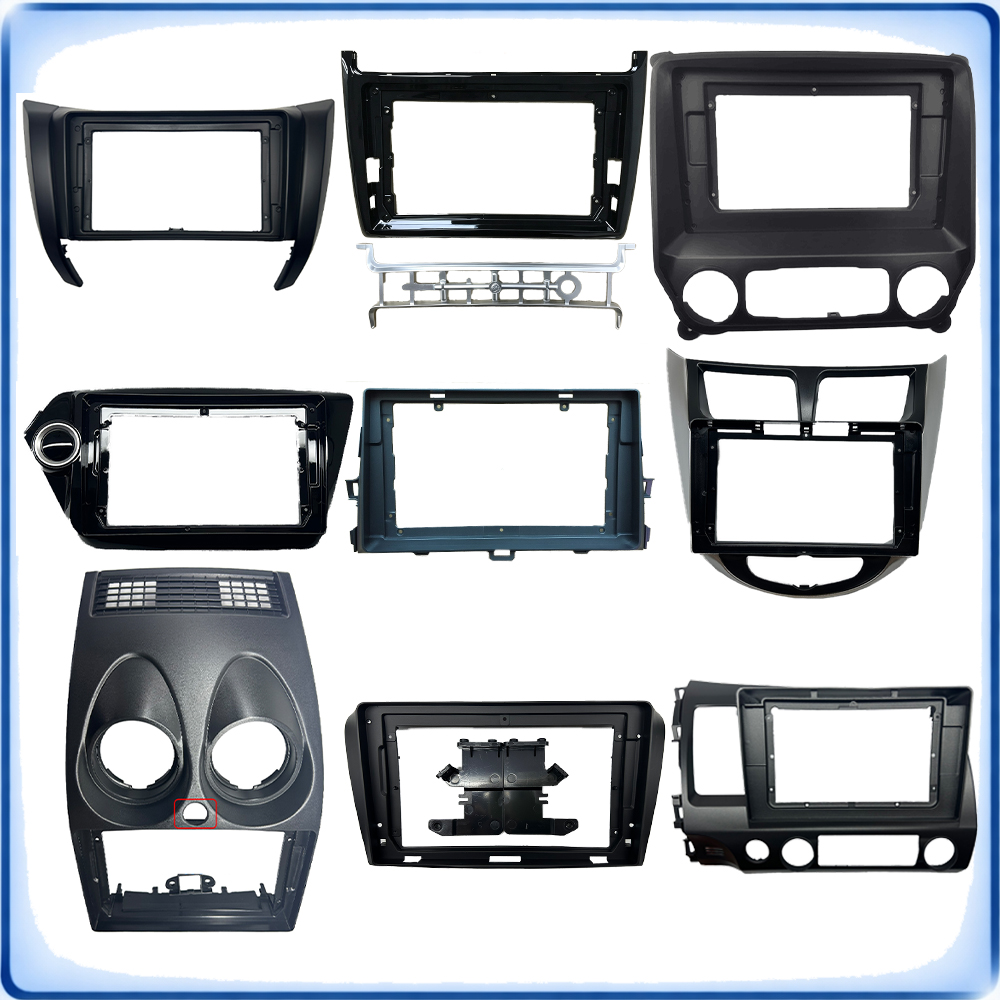
The ZYX-01 Car Radio Dash Fascia is manufactured based on original vehicle dashboard data, which is what makes fitment repeatable across a model range instead of approximate. Published specifications: material ABS plastic; material thickness 2.5 mm to 3.0 mm; dimensional tolerance ≤0.2 mm; operating temperature -40°C to 85°C; compatible screen sizes 7 inches, 9 inches, 10.1 inches and 12.3 inches; mounting standard Double-DIN and model-specific custom; fitment type plug-and-play; complete mounting accessories included.
In a multi-vehicle programme, three of those parameters decide most of the outcome:
- Dimensional tolerance ≤0.2 mm — this is the parameter that controls visible gaps and unwanted contact with the original trim.
- Material thickness 2.5–3.0 mm in ABS — this controls rigidity at the mounting points and behaviour under high cabin temperatures; the part is rated from -40°C to 85°C.
- Screen-size coverage of 7", 9", 10.1" and 12.3" — this lets one programme cover several head unit SKUs with a limited number of frame families rather than one frame per SKU.
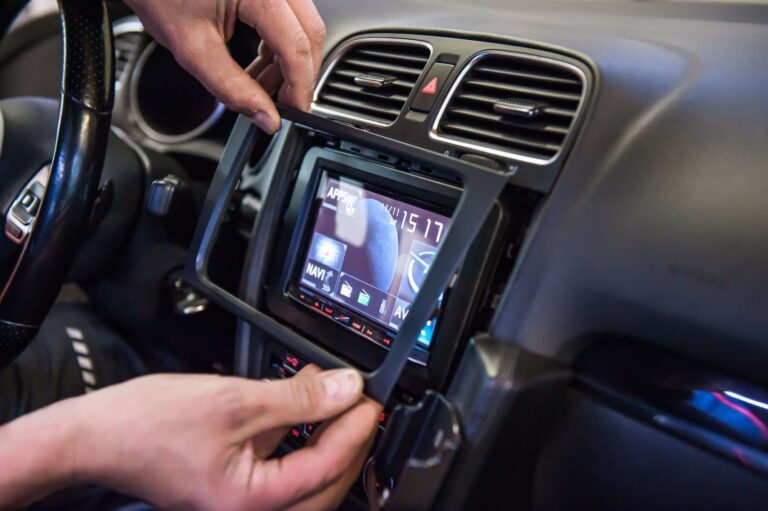
The mounting standard is model-specific custom, with Double-DIN where the dashboard allows it. Where a dashboard permits an adjustable Double-DIN solution, one frame can serve several variants of the same model. Where it does not, only a model-specific mould delivers a factory-like result. Fitment is plug-and-play and the product supports installation without damage to the original interior. A dry fit before permanent installation remains the correct verification step, because a frame that is dimensionally correct still has to be checked against the specific trim level in front of the installer.
Interface 2 — Wiring harness adaptation: the electrical interface (ZYX-02 Car Radio Wiring Harness)
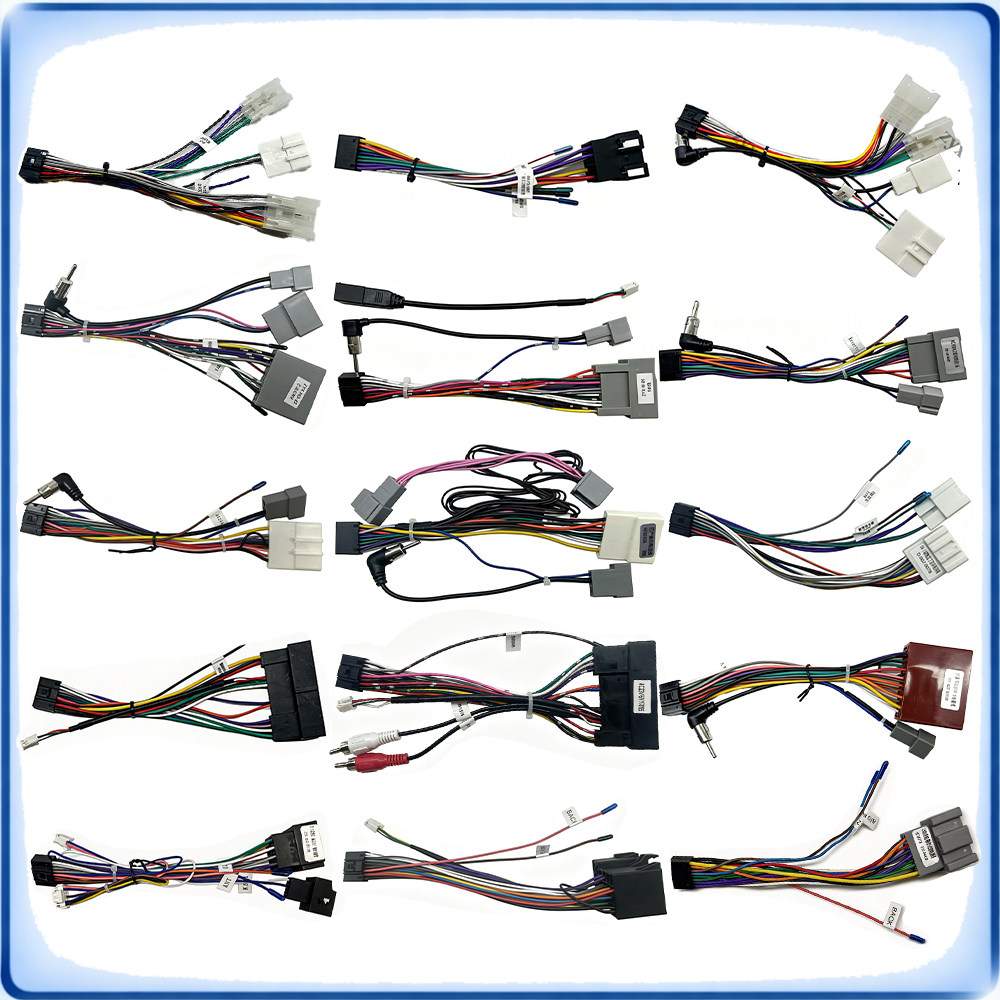
The ZYX-02 Car Radio Wiring Harness is designed for non-CAN bus vehicle models and works with most aftermarket car stereos, including most aftermarket Android head units. Its connector configuration is an OEM vehicle-side plug plus an ISO 16-pin head unit connector — the combination that makes it simultaneously vehicle-specific and head-unit agnostic. One harness family can therefore serve several head unit SKUs while still matching each vehicle's factory plug.
Published construction and ratings:
- Conductor: AWG 20-22 tinned oxygen-free copper
- Insulation: flame-retardant PVC, colour-coded in accordance with ANSI/CTA-2015-B
- Connector housing: PA66 engineering plastic; contact terminals: tin-plated brass
- Rated voltage 12 V DC, maximum current 10 A
- Operating temperature -40°C to 85°C
- Protection features: reverse polarity protection and short-circuit protection
- Installation: plug-and-play without cutting the original vehicle wiring
Four of these specifications carry direct project consequences. The OEM vehicle-side plug is what makes the harness model-specific; the ISO 16-pin side is what makes it reusable across head unit SKUs. ANSI/CTA-2015-B colour coding shortens diagnosis time when an installer works on an unfamiliar model. Tinned oxygen-free copper conductors and tin-plated brass terminals resist corrosion and support stable long-term conductivity. Reverse polarity and short-circuit protection address the specific failure mode that damages head units during unprofessional installation.
Material choice is also a long-term reliability question. Intermittent signal loss and functional failure after extended use are typically associated with low-grade copper conductors, thin insulation layers and the absence of vibration-resistant crimp design for vehicle driving conditions. The conductor and terminal specifications listed above are the practical checks a buyer can apply without destructive testing.
Interface 3 — CAN bus decoding: the communication interface (ZYX-03 CAN Bus Decoder Module)
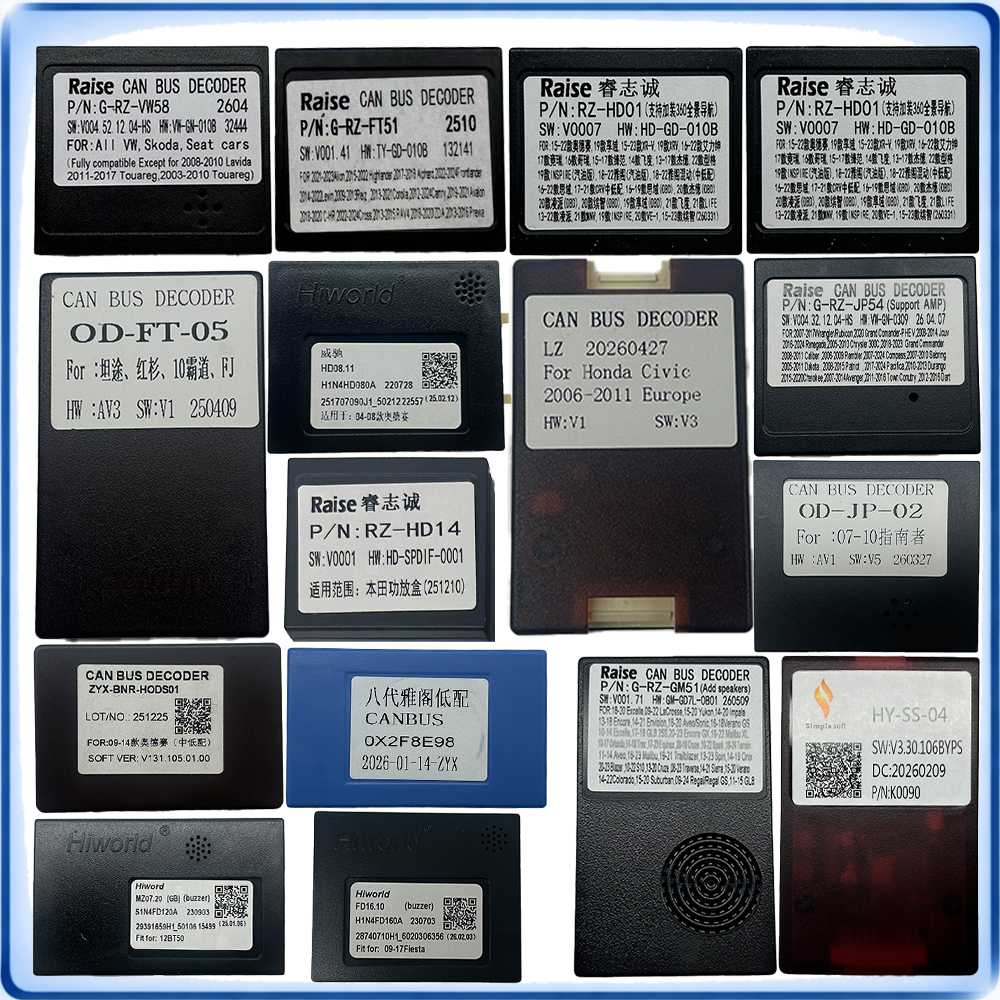
A CAN bus decoder is an automotive electronic component that enables signal communication between an aftermarket head unit and the vehicle's original CAN bus system. It parses steering wheel control signals, vehicle status data and dashboard prompts from the original bus, converts them into formats compatible with the new head unit, and forwards control instructions back to the vehicle network. In technical terms, decoders translate vehicle network messages into UART messages for the head unit so that functions such as steering wheel controls and vehicle data are retained (Quality Mobile Video technical explainer).
The ZYX-03 is supplied as a plug-and-play CAN gateway module. Published specifications:
- Protocol standard: CAN 2.0A / CAN 2.0B, dual data rate 500 kbps and 125 kbps
- Power supply: 12 V DC; 300 mA standby, 2 A maximum
- Operating temperature: -40°C to 85°C
- Housing: flame-retardant ABS plastic; connector terminals: tin-plated brass
- Circuit board: FR-4 glass fibre epoxy resin; internal potting: heat-conductive silicone
Firmware, not hardware, is the decisive part of CAN decoding. The module is pre-programmed with model-specific software so that installation is plug-and-play without on-site debugging. It is intended to retain OEM steering wheel control functions when used with an aftermarket Android head unit, and to retain vehicle information display and original chime functions after installation. It includes built-in CAN isolation intended to prevent dashboard fault codes, and it undergoes 100% incoming quality inspection.
Limitation to plan around: because vehicle configurations can vary significantly between model years and equipment levels, the exact vehicle model, year, original radio, connector and configuration should be confirmed before ordering. A decoder is only as reliable as the vehicle data behind it, and this is why the matching chain in the problem definition above matters more on the electronic interface than on any other part of the kit.
Step-by-Step Breakdown: Running a Multi-Vehicle Fascia Kit Project
The workflow below is the sequence used to keep fitment, protocol and production consistent when a single Android head unit platform is deployed across many vehicle models.
- Build the vehicle matrix before ordering anything. Record vehicle brand, model, model year, original radio, original connector, vehicle configuration, audio system and the new head unit for every model in the programme. This matrix becomes the master document for the project.
- Classify each model as CAN or non-CAN. Non-CAN vehicles are served by the ZYX-02 Car Radio Wiring Harness; CAN-equipped vehicles additionally require a ZYX-03 CAN Bus Decoder Module with firmware for that model, year and trim. Classifying at this stage prevents the most expensive error in the programme: shipping a compatible frame with an incompatible decoder.
- Match the frame by screen size and mounting standard. Select 7", 9", 10.1" or 12.3" compatibility according to the head unit SKU, and confirm whether the dashboard accepts a model-specific frame or an adjustable Double-DIN variant. Confirm that complete mounting accessories are included for the specific installation.
- Dry fit before permanent installation. Test-fit the model-specific dash kit and check alignment accuracy against the actual trim level in the vehicle. Dry fitting is the cheapest way to catch a year or trim mismatch, and it protects the original dashboard from unnecessary contact damage.
- Connect the harness and decoder to the factory interface. Disconnect the vehicle battery first to avoid electrical short circuits, then plug the wiring harness and CAN bus decoder into the original vehicle wiring interface. Do not pry dashboard trim forcibly, and confirm that all connectors are fully seated before final assembly.
- Power on and verify the full function list. Confirm steering wheel controls, original chime, vehicle information display and the absence of dashboard fault codes. If a fault code does appear, the usual causes are an incompatible decoder protocol, a loose CAN bus interface connection or a mismatched firmware version — re-seat the CAN interface, confirm the decoder is the model-specific version for the vehicle, update to the latest matching firmware, clear historical fault codes and retest.
- Freeze the per-model bill of materials and lock the kit combination. Once a model is validated, record the exact frame, harness and decoder combination. For repeat and custom orders this is what turns a one-off installation into a repeatable programme — ZYX supports kit combination configuration as part of its OEM and ODM customisation scope, alongside dash kit model and surface finish, and wiring harness pin definition and length.
Use Cases: Where Multi-Vehicle Kit Programmes Are Applied
Case 1 — Car multimedia brand owner operating a multi-model Android head unit line
The clearest evidence for the three-interface approach comes from a car multimedia brand owner working across global and Chinese markets. The relationship has run for nine continuous years, with cumulative deliveries of more than 550,000 sets covering dash frames, wiring harnesses and CAN bus decoders for multi-vehicle Android head unit retrofits. Reported results include a return rate below 0.7%, excellent protocol compatibility, stable mass production, fast new-model adaptation and support for multi-country compliance standards. The buyer's stated highlights are a complete vehicle-model database, precise CAN bus decoding, assembly fit, efficient sample delivery and stable lead-time control.
Case 2 — After-market solution integrator building kits for multiple car brands
A second programme illustrates the same logic from the kit-assembly side. An after-market solution integrator in China has worked with ZYX for seven years, taking cumulative delivery of more than 19,000 sets of Android stereo retrofit supporting parts — dash frames, wiring harnesses and CAN bus decoders across various car brands. Reported results include a return rate below 0.8%, consistent product consistency, flexible order volume and rapid technical support for overseas project requirements, with high-precision frame dimensions, reliable harness connections and a mature protocol solution cited as the highlights.
Case 3 — Distributors and installers serving fleet, dealership and refurbishment demand
The application profile that generates most multi-vehicle demand is a mixed installation environment: aftermarket car head unit upgrades, centre console navigation retrofits, used car interior electronics refurbishment, fleet audio system upgrades and car dealership accessory fitting. In these environments the kit has to work inside an in-vehicle operating envelope that includes a wide temperature range from -40°C to 85°C, constant road vibration, dust and humidity exposure, an automotive EMI environment and a 12 V DC vehicle electrical system. The stated special requirements for these projects are model-specific precise fitment, no damage to original wiring or interior, zero dashboard fault codes, automotive EMC compliance, high temperature resistance under direct sunlight and flame-retardant wiring materials.
Comparison Table: What Each Part of the Kit Is Responsible For
| Dimension | ZYX-01 Car Radio Dash Fascia | ZYX-02 Car Radio Wiring Harness | ZYX-03 CAN Bus Decoder Module |
|---|---|---|---|
| Interface solved | Mechanical: dashboard opening and head unit mounting | Electrical: OEM connector to ISO head unit connector | Communication: vehicle CAN network to aftermarket head unit |
| Key published specifications | ABS plastic; thickness 2.5–3.0 mm; tolerance ≤0.2 mm; -40°C to 85°C | AWG 20-22 tinned oxygen-free copper; ANSI/CTA-2015-B colour coding; 12 V DC, 10 A max; -40°C to 85°C | CAN 2.0A / 2.0B; 500 kbps and 125 kbps; 12 V DC, 300 mA standby and 2 A max; -40°C to 85°C |
| Compatibility basis | Original vehicle dashboard data; 7"/9"/10.1"/12.3" screens; Double-DIN and model-specific custom | OEM vehicle-side plug plus ISO 16-pin head unit connector; non-CAN bus vehicle models | Pre-programmed model-specific firmware; CAN-equipped vehicles |
| Integration and protection features | Complete mounting accessories; plug-and-play fitment; no damage to original interior | Reverse polarity protection; short-circuit protection; plug-and-play without cutting original wiring | Built-in CAN isolation intended to prevent dashboard fault codes; 100% incoming quality inspection |
| Typical consequence if unmatched | Gaps, misalignment, original trim damage | Short-circuit risk, head unit damage, cut original wiring | Dashboard fault codes, inoperative steering wheel controls |
| Vehicle-model dependency | Per-model mould, or adjustable variant where the dashboard allows | Per-model connector and pin definition | Per-model firmware and protocol version |
FAQ
Two layers apply. The first is environmental compliance: the retrofit kit is stated to comply with EU RoHS 2 and REACH regulations, with controlled hazardous substance content across materials and components. The second is vehicle-level EMC compliance: electronic subassemblies integrated into road vehicles in the EU must comply with e/E-Marking (EMC testing, ECE R10) rather than only CE marking if they affect vehicle safety functions, according to Elite Electronic Engineering's e/E-Marking guidance. For customs and trade documentation, car stereo fascia and installation hardware is commonly classified under HS Code 8708.99 (vehicle parts and accessories, n.e.c.) per the United Nations Statistics Division. Buyers running multi-country programmes should also note that the case evidence for multi-vehicle supply includes support for multi-country compliance standards.
Evaluate against five verifiable criteria rather than brand claims. First, model-specific precision moulding based on original vehicle dashboard data, with a published dimensional tolerance (ZYX-01 states ≤0.2 mm). Second, pre-flashed vehicle-specific CAN firmware rather than a generic decoder, because protocol matching determines whether steering wheel controls and vehicle data survive the upgrade. Third, plug-and-play wiring harnesses with built-in electrical protection such as reverse polarity and short-circuit protection. Fourth, a published quality inspection regime — ZYX applies 100% incoming inspection for CAN bus decoders and 100% pre-shipment conductivity and fit testing. Fifth, whether the supplier can quote a fascia, harness and decoder as one matched combination for a given vehicle model, year, original radio, connector and configuration, rather than as three unrelated parts. A practical test is to request a matched kit list against a short vehicle matrix and see how many questions the supplier asks about model year, trim level and connectors.
Commercial terms follow the order route, not the vehicle count. Stock items start at a minimum order quantity of 1 unit with a lead time of 3–7 days, which supports single-set evaluation and small top-up orders. Custom OEM or ODM items start at 100 units with a lead time of 15–25 days. Monthly production capacity is 12,000 units. The cost drivers inside a custom programme are the model-specific dash kit mould and surface finish, wiring harness pin definition and length, firmware programming for each vehicle model, and the kit combination configuration requested for the programme. Because component content per vehicle model is what changes, the most reliable way to compare quotations is against a frozen per-model bill of materials rather than against a headline unit figure.
Use the stock route for validation. Stock items can be ordered from a minimum of 1 unit, which allows a single vehicle to be fitted and checked before a programme is scaled. The validation steps are: confirm the exact vehicle model, model year and trim level; supply clear photos of the original dashboard, original radio, or the connectors on the back of the original head unit, because a model with multiple equipment configurations cannot be matched from the model name alone; dry fit the dash kit to check alignment; connect the harness and decoder to the factory interface with the battery disconnected; then verify steering wheel controls, original chime, vehicle information display and the absence of dashboard fault codes. Case evidence for the multi-vehicle supply route includes efficient sample delivery as a stated buyer highlight. ZYX backs the product with a 12-month warranty, remote installation technical guidance and free replacement for defective items.
Plan around two routes. Stock products ship in 3–7 days; custom model-specific products take 15–25 days from a 100-unit minimum. Monthly capacity is 12,000 units, which is the figure to check against your programme's ramp-up curve. After-sales support includes a 12-month product warranty, remote installation technical guidance, free replacement for defective items and professional CAN protocol matching support. To start a programme, send your vehicle matrix together with photos of the original dashboard, original radio or the connectors on the back of the original head unit, and ZYX will return a matched fascia, harness and decoder list per model.
Conclusion
Multi-vehicle Android head unit projects succeed or fail on three interfaces, and each one has a different matching logic. The dash frame is matched to the vehicle's dashboard geometry and to the head unit's screen size, with dimensional tolerance and material thickness determining whether the result looks factory-fitted. The wiring harness is matched to the OEM vehicle-side connector on one end and standardised to an ISO 16-pin head unit connector on the other, which is what allows one harness family to serve several head unit SKUs. The CAN bus decoder is matched to the vehicle's protocol, model year and trim level through pre-programmed firmware, which is what keeps steering wheel controls, vehicle information and chime functions alive and keeps dashboard fault codes away.
Shenzhen Zhongyixing Electronic Technology Co., Ltd (ZYX) is a professional car stereo fascia kit and installation solution provider founded in 2017, operating a 5,000 m² facility with an annual output of 1,000,000 units and a product system covering 3,000+ vehicle applications, with more than 10 years of accumulated experience in automotive aftermarket electronics and an export share of 80% concentrated in Russian and EU markets. The company's working process runs the full chain — vehicle data, product development, sample testing, production, quality control, warehousing, global sales and after-sales support — and its stated objective is not simply to manufacture a product but to provide parts that complete the vehicle upgrade and installation process.
Planning a multi-vehicle Android head unit programme?
Send your vehicle list together with dashboard, original radio or connector photos, and ZYX will return a matched fascia kit, wiring harness and CAN bus decoder combination per vehicle model. Stock items can be ordered from 1 unit for validation; custom OEM/ODM kits start at 100 units.
Website: www.zyxcaradio.com
Email: yueyongfei7@gmail.com
WhatsApp / Tel: +86 159-2064-3862
Address: 5th Floor, Building D, Tianxi Sheng, No.46 Hongyin Road, Loucun Community, Xinhu Street, Guangming District, Shenzhen, China
Download the full company and product profile brochure: ZYX Auto Company Profile Brochure (PDF)
Have Questions or Need More Details?
Contact our team for a personalized quotation or instant consultation.
Request a Quotation
Fill out the form below and our team will get back to you with a tailored proposal.
WhatsApp Direct Chat
Prefer to chat in real-time? Message us on WhatsApp for instant assistance & quick answers.
- Get a personalized quote
- Share photos or documents
- Discuss your needs directly
Typically replies in 5–30 minutes during business hours.