
Compliance Guide: ANSI/CTA-2015-B, ISO 16-Pin, and Multi-Country Rules for Vehicle-Specific Android Car Stereo Fascia Kits
Direct answer: A vehicle-specific Android car stereo fascia kit is compliant only when six layers can be documented with values rather than adjectives. Those layers are dimensional fit against the original dashboard; material and operating-temperature ratings; the ANSI/CTA-2015-B wiring color code; the connector interface, an OEM vehicle-side plug on one end and an ISO 16-pin head unit connector on the other; vehicle protocol communication through a matching CAN decoder; and the regulatory file each destination market requires, including RoHS 2, REACH, EMC e-marking scope and HS classification. A kit that can prove these six layers installs predictably. A kit that only describes them absorbs the difference in returns, rework and customs delays.
This guide is written for the evaluation stage of sourcing — importers, distributors, installers, car multimedia brand owners and fleet buyers who have already decided to use a vehicle-specific Android head unit fascia kit and now need to verify that the exact kit they are buying will pass fitment, electrical and cross-border checks. Every check below applies to any Android car stereo fascia kit, double DIN fascia kit or car stereo dash kit built for a specific vehicle application. The ZYX Car Radio Fascia Kit range — ZYX-01 Car Radio Dash Fascia, ZYX-02 Car Radio Wiring Harness and ZYX-03 CAN Bus Decoder Module — is used as the worked example, because its specifications are published as measurable values.
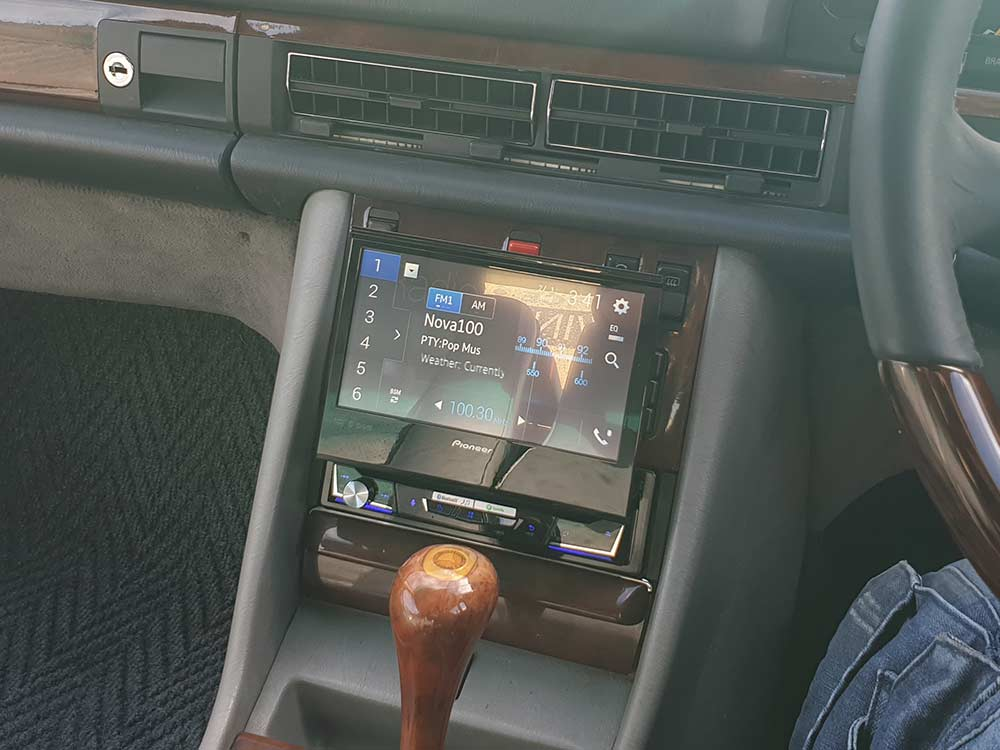
Figure 1 — A completed retrofit: the vehicle-specific fascia kit closes the gap between the factory dashboard and the aftermarket head unit without trim modification. Image: ZYX Car Radio Fascia Kit.
Problem Definition: Why Compliance Failures Surface After the Sale
At quotation stage, a vehicle-specific Android car stereo fascia kit looks like moulded plastic and a bundle of wire. In service, the failures it produces fall into three clusters — and all three are data problems rather than manufacturing accidents.
- Physical failures: visible gaps between the fascia and the dashboard, misalignment around the head unit opening, cracked mounting points, or scratched factory trim.
- Electrical failures: reversed power circuits, blown fuses, a head unit that will not power on, or, in the worst case, damage to the vehicle's original electrical system.
- Communication failures: dashboard fault warning codes, unresponsive steering wheel buttons, and intermittent signal loss that appears months after installation.
Each cluster maps to a single missing parameter. Physical failures map to a dimensional tolerance that was never published. Electrical failures map to a pin definition or a wiring color code that was assumed rather than confirmed. Communication failures map to a CAN protocol version that does not match the vehicle's model year or trim level. When those parameters are not documented, the buyer absorbs the variance — in rework time, in replacement shipments, and in installer confidence.
In aftermarket practice, the two pain points that generate the largest share of returns and technical support requests in this category are fitment accuracy and CANBUS protocol compatibility, not the base quality of the plastic or the copper. That is why a compliance review is more useful at the evaluation stage than a price comparison: it separates kits that install predictably from kits that install differently in every vehicle.
Cross-border distribution adds a second layer of exposure that has nothing to do with the installer. A kit can be mechanically and electrically sound and still be delayed by a missing RoHS 2 or REACH declaration, by an unanswered question about whether the harness or decoder falls inside EMC e-marking scope for the destination market, or by an incorrect HS code on the commercial invoice. In each case the cost is not the part — it is the shipment, the storage and the customer relationship.
Treating compliance as product data, rather than as paperwork added just before shipment, removes most of that variance. The six layers below are the ones that matter for a fascia kit.
Industry Background: Why Compliance Became a Purchasing Criterion
The compliance question is growing because the market behind it is growing. The global car audio head unit market was estimated at USD 15.44 billion in 2024 (Market Research Future, Car Audio Head Unit Market Size, Trends, Growth Report 2035). The car aftermarket audio system segment is projected to grow at a CAGR of 12.18%, with DIY customers and online plug-and-play kits among the demand drivers (Mordor Intelligence, Car Audio Market Size, Outlook & Analysis, 2031). Asia Pacific accounted for a 54.21% share of the global car audio market in 2025 (Fortune Business Insights, Car Audio Market Size, Revenue, Growth, Global Report, 2034).
Customs classification for installation hardware is already standardized at the international level. HS Code 8708.99 covers vehicle parts and accessories not elsewhere specified, and it is the primary classification for car stereo fascias and installation hardware (United Nations Statistics Division). A supplier that states this code accurately at quotation stage is usually a supplier whose documentation is organized in other places too.
Regulatory scope is the harder question. In the European Union, electronic subassemblies integrated into road vehicles must comply with e-Marking (EMC testing) rather than only CE marking where they can affect vehicle safety functions (Elite Electronic Engineering, Guide to e/E-Marking). Because a wiring harness and a CAN bus decoder sit inside the vehicle's electrical network, importers need a documented answer for the exact configuration they sell, not a general statement about the brand.
ZYX Car Radio Fascia Kit is the fascia, harness and CANBUS product line of Shenzhen Zhongyixing Electronic Technology Co., Ltd, a Shenzhen-based automotive aftermarket manufacturer founded in 2017. The company operates a 5,000 m² facility, exports approximately 80% of its output with RU and EU as its main markets, and maintains a vehicle compatibility database covering 3,000+ vehicle applications across popular models in Europe, North America, Asia, South America and the Middle East. Monthly production capacity is 12,000 units. Its product structure — fascia kit, wiring harness and CANBUS decoder — is organized around precisely the three interfaces that a compliance review examines.
Detailed Solution: The Six Documentation Layers of a Compliant Fascia Kit
A kit passes an evaluation when each layer below is documented with a value, a standard reference or a test record. Claims without values are not layers.
Layer 1 — Dimensional fit: tolerance, thickness and mounting standard
The fascia is the part the customer sees, and it is judged in millimetres. The ZYX-01 Car Radio Dash Fascia is moulded in ABS plastic with a dimensional tolerance of ≤0.2 mm and a material thickness of 2.5–3.0 mm. It supports a Double-DIN mounting standard or model-specific custom mounting, covers 7", 9", 10.1" and 12.3" screen sizes, and uses a plug-and-play fitment type.
The tolerance figure is what separates a factory-like seam from a visible gap. Because the same vehicle model can change dashboard geometry between model years and equipment levels, two buyers ordering "the fascia for model X" may need different physical parts. During evaluation, ask for the tolerance value and the mounting standard in writing, and confirm the screen size the installer intends to fit.
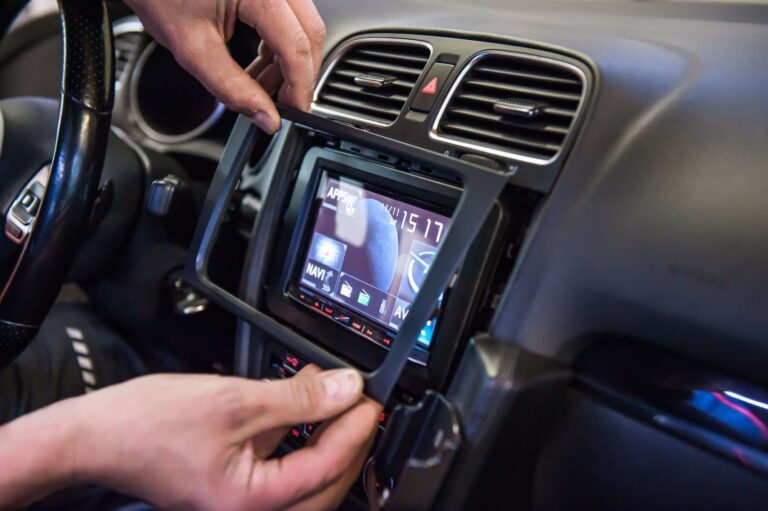
Figure 2 — Dry-fitting a model-specific dash kit and checking alignment accuracy before final assembly. Image: ZYX Car Radio Fascia Kit.
Layer 2 — Materials and the −40°C to 85°C operating envelope
Materials are a compliance layer because they determine both durability and chemical declarations. The three ZYX components use different materials for different jobs but share one thermal specification:
- ZYX-01 Car Radio Dash Fascia: ABS plastic, operating temperature −40°C to 85°C.
- ZYX-02 Car Radio Wiring Harness: tinned oxygen-free copper conductor, flame-retardant PVC insulation, PA66 engineering plastic connector housing, tin-plated brass contact terminals, operating temperature −40°C to 85°C.
- ZYX-03 CAN Bus Decoder Module: flame-retardant ABS plastic housing, tin-plated brass connector terminals, FR-4 glass fiber epoxy resin circuit board, heat-conductive silicone internal potting, operating temperature −40°C to 85°C.
A dashboard is an aggressive environment: direct sun load, cabin heat, constant road vibration, dust and humidity, all inside a 12V DC electrical system. A shared −40°C to 85°C operating range across fascia, harness and decoder means the three parts are specified to the same thermal envelope, which simplifies validation for distributors running multi-vehicle programs. The flame-retardant specification of the PVC insulation and the ABS housing is also the material property that supports the environmental declarations discussed in Layer 6.
Layer 3 — Wiring color code: ANSI/CTA-2015-B and conductor construction
The ZYX-02 Car Radio Wiring Harness uses ANSI/CTA-2015-B color-coded insulation and AWG 20–22 tinned oxygen-free copper conductors. ANSI/CTA-2015-B is the wiring color-code reference published by the American National Standards Institute and the Consumer Technology Association, and its practical role is simple: it lets an installer identify circuit function by insulation color instead of tracing wires with a meter.
Two verification rules follow from that. First, the color code identifies function — constant power, switched power, ground, speaker or control — but it does not replace the vehicle-side pin definition; a compliant shipment should include a pin-out table, and the installer should confirm the harness against the specific vehicle rather than assume. Second, conductor construction matters as much as the color: tinned oxygen-free copper resists corrosion better than untinned copper in humid cabin conditions, and it is the material choice that reduces the intermittent signal loss that appears after years of vibration. The ZYX-02 harness is rated at 12V DC with a 10A maximum current and includes reverse polarity protection and short-circuit protection.
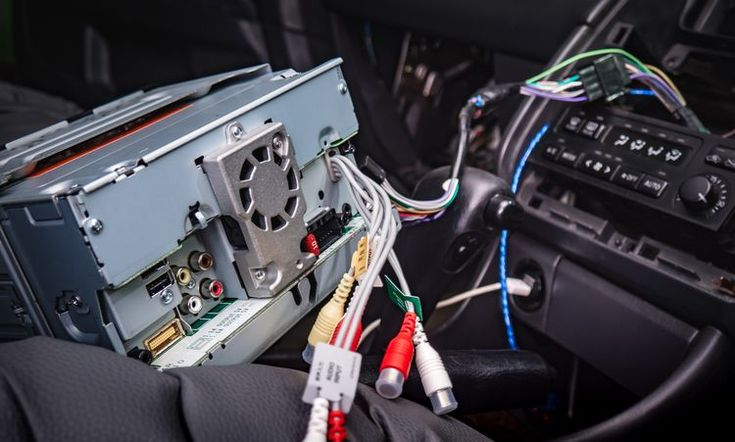
Figure 3 — Plugging the dedicated wiring harness and CAN bus decoder into the vehicle's factory electrical interface. Image: ZYX Car Radio Fascia Kit.
Layer 4 — Connector interface: OEM vehicle-side plug plus ISO 16-pin head unit connector
The connector is where compliance becomes commercial. ZYX-02 uses an OEM vehicle-side plug on one end and an ISO 16-pin head unit connector on the other. The vehicle-side end must match the factory connector of the target vehicle; the head unit end follows the ISO 16-pin interface used by most aftermarket car stereos, and the harness is specified for non-CAN bus vehicle models.
This two-ended logic is why plug-and-play kits distribute across markets more easily than cut-and-splice solutions. No original wiring is cut or modified, the factory harness stays intact, and the installation becomes reversible — a requirement in dealership pre-delivery fitting, fleet programs and used-car refurbishment, where the vehicle may later need to be returned to stock configuration.
Layer 5 — Vehicle communication: CAN 2.0A/2.0B and firmware matching
On CAN-equipped vehicles, the decoder is the compliance risk. The ZYX-03 CAN Bus Decoder Module supports CAN 2.0A / 2.0B at a 500 kbps / 125 kbps dual data rate, runs on 12V DC with 300 mA standby and a 2A maximum, and operates from −40°C to 85°C. Its function is translation: a decoder converts vehicle network messages (HEX codes) into UART messages the Android head unit can read, which is how steering wheel controls and selected vehicle data are retained after the factory radio is removed.
The failure mode this addresses is well documented. Dashboard fault warning codes and unresponsive steering wheel controls are typically caused by an incompatible decoder protocol, a loose CAN bus interface connection, or a decoder firmware version that does not match the vehicle. The remedy is a matching process, not a repair: confirm the decoder is the model-specific version for the vehicle, re-seat the CAN bus interface connector, update the decoder to the matching firmware, then clear historical fault codes and retest. During evaluation, the question to ask is not "does it support CAN?" but "does the firmware match my model year and trim level?"
Layer 6 — Multi-country rules: RoHS 2, REACH, e-marking scope and HS classification
Regulatory requirements are the layer that differs most between markets, and the layer where one organized documentation file saves the most time.
- EU environmental compliance: the retrofit kit is documented as complying with EU RoHS 2 and REACH regulations, with hazardous substance content strictly controlled across all materials and components.
- EU EMC scope: electronic subassemblies integrated into road vehicles must meet e-Marking (EMC testing) where they can affect vehicle safety functions, rather than relying on CE marking alone. Importers should confirm the scope status of the exact harness and decoder configuration they place on the market.
- Customs classification: HS Code 8708.99 (vehicle parts and accessories, n.e.c.) is the primary classification for fascia and installation hardware.
A practical rule for distributors and brand owners is to build one documentation package per SKU and reuse it across markets: a specification sheet with tolerance and material values, a harness pin-out table, the protocol and firmware version reference, RoHS 2 and REACH declarations, EMC documentation where applicable, the HS code statement, and lot traceability from the quality inspection records. Country-specific items can then be added to the same structure as new markets open, instead of rebuilding the file for every order.
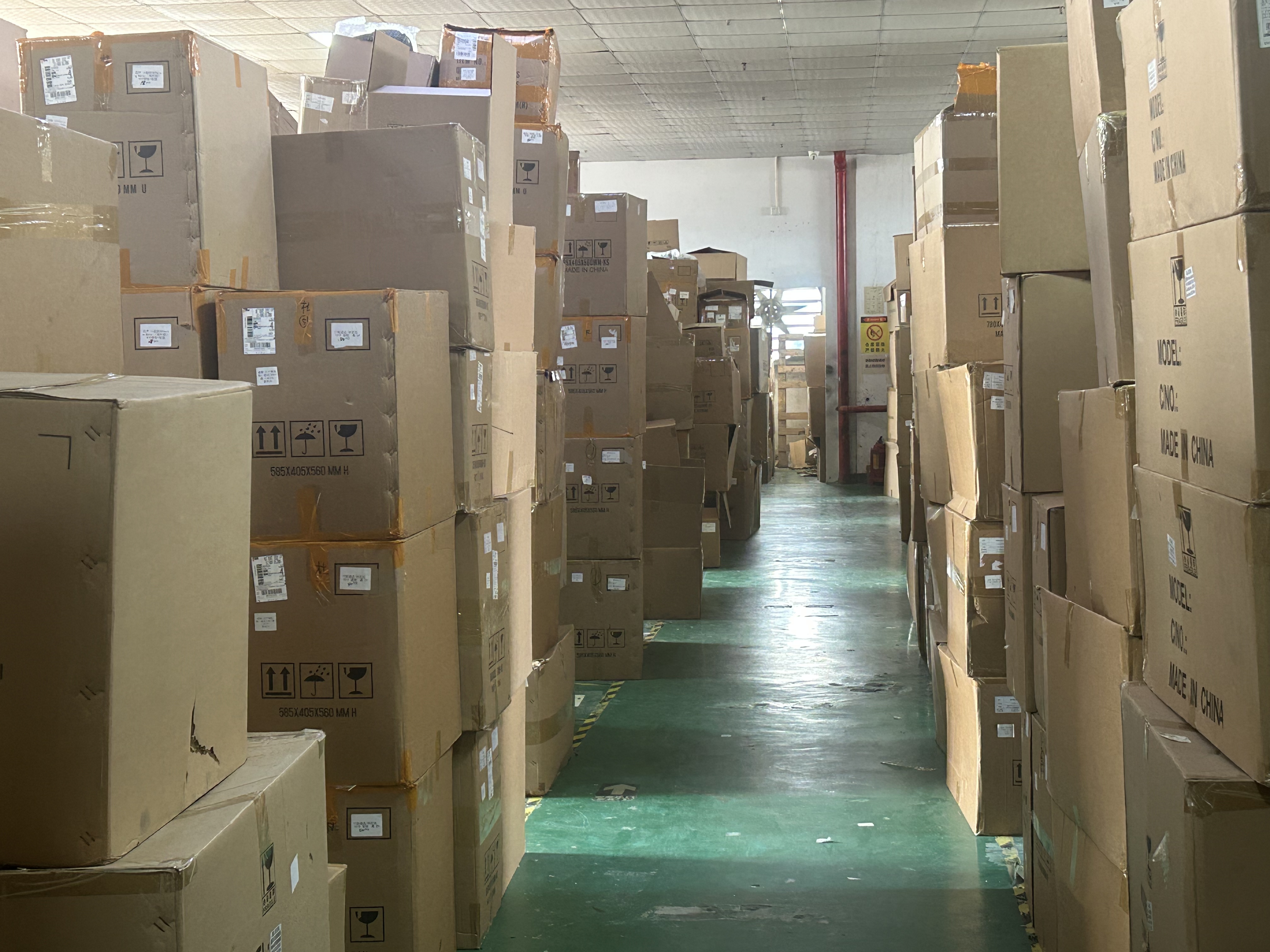
Figure 4 — Export-bound fascia kit orders staged before dispatch; specification and inspection records travel with each lot. Image: ZYX Car Radio Fascia Kit.
Step-by-Step Breakdown: A Seven-Step Compliance Check Before You Order
- Fix the vehicle identity. Compatibility depends on vehicle brand, model, model year, equipment level, original radio, original connector and audio system configuration. Clear photos of the original dashboard, the original radio, or the connectors on the back of the factory head unit reduce mismatches caused by trim-level differences.
- Read the fascia specification for values. Confirm material, dimensional tolerance, material thickness, supported screen sizes and mounting standard. "Precise fit" is not a specification; ≤0.2 mm is.
- Audit the harness. Check the color-code standard, conductor gauge and construction, both connector types, voltage and current ratings, and whether reverse polarity and short-circuit protection are included.
- Confirm the communication path. For CAN-equipped vehicles, verify the protocol standard and data rate, and confirm that decoder firmware matches the model year and trim level — not only the model name.
- Assemble the regulatory file. Collect RoHS 2 and REACH declarations, resolve EMC/e-marking scope for the configuration, and confirm the HS code used on the commercial invoice.
- Dry-fit and bench-test before final assembly. Disconnect the vehicle battery, remove the factory head unit and dashboard trim, dry-fit the dash kit to check alignment, plug the harness and decoder into the original vehicle interface, connect the new head unit and test all functions, then secure the components and reinstall the trim. Never force the trim, and confirm decoder compatibility before power-on.
- Verify shipment-level quality control. ZYX applies 100% incoming inspection for CAN bus decoders and a 100% pre-shipment conductivity and fit test — the record that turns a compliance file into evidence.
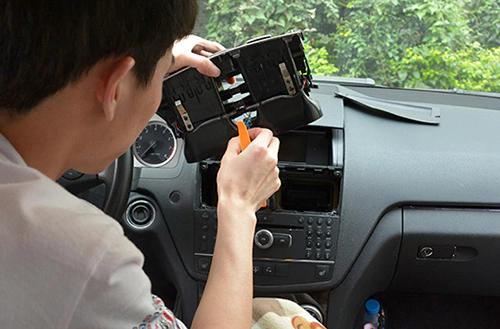
Figure 5 — Removing the factory head unit and dashboard trim panel: the reversible step that plug-and-play compliance protects. Image: ZYX Car Radio Fascia Kit.
Use Cases: Where the Compliance Layers Decide the Outcome
Dealership and fleet pre-delivery fitting
Vehicles are upgraded before delivery and may later need to be returned to stock specification. A documented plug-and-play interface — OEM vehicle-side plug to ISO 16-pin head unit connector — keeps the factory harness intact and makes the installation reversible, which matters more than unit price in this channel.
Cross-border distribution and multi-country e-commerce
Distributors selling into several markets need one specification set and one documentation file. RoHS 2 and REACH declarations, EMC scope clarification and HS Code 8708.99 classification are the items that decide whether a container clears without correspondence. ZYX supports automotive aftermarket customers across international markets, with approximately 80% of output exported and RU and EU as its main markets.
Car multimedia brand owners running multi-vehicle programs
One documented case covers a car multimedia brand owner in a 9-year continuous cooperation across global markets including China. Cumulative supply reached 550,000+ sets of dash frames, wiring harnesses and CAN bus decoders, with stable mass production, fast new-model adaptation, stable lead-time control across volume orders and efficient sample delivery; the return rate was below 0.7% over cumulative shipments. Documented highlights include support for multi-country compliance standards, a complete vehicle-model database and form-fit assembly of the dash frame with the vehicle dashboard.
After-market solution integrators delivering overseas projects
A second documented case covers an after-market solution integrator in China over a 7-year long-term stable cooperation, with cumulative supply of 19,000+ sets of Android stereo retrofit supporting parts covering dash frames, wiring harnesses and CAN bus decoders for various car brands. Recorded highlights are high-precision frame dimensions, reliable harness connection, a mature protocol solution and rapid after-sales technical response; the return rate was below 0.8%, and the program included flexible order volume capability and technical support for overseas project requirements.
Used-car refurbishment and independent installers
Where labour time is the main cost, the ANSI/CTA-2015-B color code and the plug-and-play connector reduce installation risk without on-site protocol programming. The same documentation that supports a distributor also supports an individual installer reading a specification sheet before buying.
Comparison Table: Compliance Layers, Verified Specifications and Downstream Risk
| Compliance layer | What the buyer must verify | Verified ZYX specification | Downstream risk if unverified |
|---|---|---|---|
| Dimensional fit | Tolerance, material thickness, mounting standard, screen sizes | ZYX-01: ABS plastic, dimensional tolerance ≤0.2 mm, thickness 2.5–3.0 mm, Double-DIN or model-specific custom, 7"/9"/10.1"/12.3" screens | Visible gaps, trim damage, rework |
| Thermal rating | Operating temperature of fascia, harness and decoder | −40°C to 85°C across ZYX-01, ZYX-02 and ZYX-03 | Deformation, intermittent faults |
| Wiring color code | Color-code standard and conductor construction | ZYX-02: ANSI/CTA-2015-B color-coded insulation, AWG 20–22 tinned oxygen-free copper | Mis-wiring, short circuits, blown fuses |
| Connector interface | Vehicle-side plug type and head unit-side connector standard | ZYX-02: OEM vehicle-side plug + ISO 16-pin head unit connector, for non-CAN bus vehicle models | Cut-and-splice installation, harness damage |
| Electrical protection | Protection features and electrical ratings | ZYX-02: 12V DC, 10A maximum current, reverse polarity protection, short-circuit protection | Damaged head unit, damaged vehicle electrics |
| Vehicle communication | Protocol standard, data rate, firmware matching to model year and trim | ZYX-03: CAN 2.0A / 2.0B, 500 kbps / 125 kbps dual rate, 12V DC, 300 mA standby, 2A maximum | Dashboard fault codes, lost steering wheel controls |
| Materials and environmental compliance | RoHS 2 and REACH declarations; flame-retardant materials | Flame-retardant PVC insulation, flame-retardant ABS housing, PA66 connector housing; kit documented as compliant with EU RoHS 2 and REACH | Customs hold, market entry refusal |
| Customs classification | Correct HS code on the commercial invoice | HS Code 8708.99 (vehicle parts and accessories, n.e.c.) | Clearance delay, duty disputes |
Sources: ZYX product specifications for ZYX-01, ZYX-02 and ZYX-03; United Nations Statistics Division for HS Code 8708.99; Elite Electronic Engineering for EU e-Marking scope.
Frequently Asked Questions
What compliance documents should a supplier provide for a vehicle-specific Android car stereo fascia kit exported to the EU?
The documentation set should cover environmental compliance, EMC scope and customs classification. The ZYX retrofit kit is documented as complying with EU RoHS 2 and REACH regulations, with hazardous substance content controlled across all materials and components, including the flame-retardant PVC insulation of the wiring harness and the flame-retardant ABS housing of the CAN bus decoder. Because electronic subassemblies integrated into road vehicles must meet e-Marking (EMC testing) rather than only CE marking where they can affect vehicle safety functions, buyers should confirm the e-marking scope of the specific harness and decoder configuration with the importer of record. HS Code 8708.99 (vehicle parts and accessories, n.e.c.) is the primary classification for this hardware, and the supplier should state it so the commercial invoice matches the customs declaration.
Can a plug-and-play fascia kit avoid dashboard fault codes and keep steering wheel controls working?
Yes, when the decoder firmware matches the vehicle rather than the vehicle family. Dashboard fault warning codes and unresponsive steering wheel buttons usually trace to an incompatible CAN decoder protocol, a loose CAN bus interface connection, or a mismatched decoder firmware version. The corrective sequence is: confirm the decoder is the model-specific version for the vehicle, re-seat the CAN bus interface connector, update the decoder to the matching firmware, then clear the vehicle's historical fault codes and retest the system. The ZYX-03 CAN Bus Decoder Module supports CAN 2.0A / 2.0B at a 500 kbps / 125 kbps dual data rate and operates from −40°C to 85°C, and the plug-and-play principle is that the kit reaches the vehicle's CAN network through the factory electrical interface without cutting or modifying the original wiring harness.
What are the MOQ and order options for a compliance-ready fascia kit set?
Order routes are split by whether the part already exists. ZYX stock items start at a MOQ of 1 unit, while custom OEM/ODM items start at 100 units. Production modes include OEM, ODM, kit assembly and authorized distribution, and customization is available for dash kit model and surface finish, wiring harness pin definition and length, and kit combination configuration. Monthly capacity is 12,000 units.
Can I validate fitment and compliance with a sample before placing a bulk order?
Yes. A sample route is the standard way to validate a vehicle-specific Android car stereo fascia kit before a volume commitment: dry-fit the dash kit against the dashboard, plug the wiring harness and CAN bus decoder into the factory interface, connect the head unit and test all functions, then confirm that the specification sheet, pin-out table and declarations match what was quoted. Sample delivery and lead-time control are documented elements of ZYX's long-term supply programs.
What lead times apply to stock and custom vehicle-specific fascia kits?
ZYX quotes 3–7 days for stock products and 15–25 days for custom model-specific products. Volume programs are supported by a monthly capacity of 12,000 units, and long-term supply references include stable lead-time control across volume orders, plus a 12-month product warranty with remote installation technical guidance. Buyers comparing stock availability against a custom program can request a sample or a quotation through the company profile brochure linked at the end of this guide.
Conclusion: Compliance Is the Difference Between a Part and a Program
A vehicle-specific Android car stereo fascia kit is not a single product but a chain of interfaces: the fascia to the dashboard, the harness to the factory plug, the ISO 16-pin connector to the head unit, the decoder to the vehicle network, and the shipment to the destination market's rules. Each link has a value attached to it — ≤0.2 mm of tolerance, ANSI/CTA-2015-B color-coded insulation, an ISO 16-pin head unit interface, CAN 2.0A / 2.0B at 500 kbps / 125 kbps, a shared −40°C to 85°C thermal envelope, RoHS 2 and REACH declarations, and HS Code 8708.99. Documented together, they turn an installation accessory into a repeatable program that distributors can forecast, installers can trust and customs can clear.
That is the standard ZYX builds against: 3,000+ vehicle applications, a monthly capacity of 12,000 units, 100% incoming inspection for CAN bus decoders and a 100% pre-shipment conductivity and fit test, supported by long-term programs with a car multimedia brand owner (550,000+ sets, return rate below 0.7%) and an after-market solution integrator (19,000+ sets, return rate below 0.8%).
Next step: verify the six layers on your own vehicle list
Request a sample, a quotation or the full ZYX company profile with product specifications for fascia kits, wiring harnesses and CAN bus decoders. The technical team can review your vehicle model, model year and trim level against the compatibility database before you commit to a program.
Company profile brochure: Download the ZYX AUTO company profile (PDF)
Website: www.zyxcaradio.com
Contact: Rip — Email: yueyongfei7@gmail.com | Tel / WhatsApp: +86 159-2064-3862
Address: 5th Floor, Building D, Tianxi Sheng, No.46 Hongyin Road, Loucun Community, Xinhu Street, Guangming District, Shenzhen, China

Figure 6 — Specification review before quotation: matching vehicle model, model year and trim level to the correct fascia, harness and CAN decoder combination. Image: ZYX Car Radio Fascia Kit.
Have Questions or Need More Details?
Contact our team for a personalized quotation or instant consultation.
Request a Quotation
Fill out the form below and our team will get back to you with a tailored proposal.
WhatsApp Direct Chat
Prefer to chat in real-time? Message us on WhatsApp for instant assistance & quick answers.
- Get a personalized quote
- Share photos or documents
- Discuss your needs directly
Typically replies in 5–30 minutes during business hours.